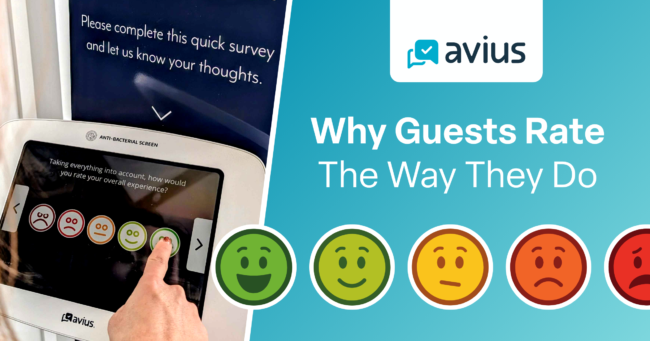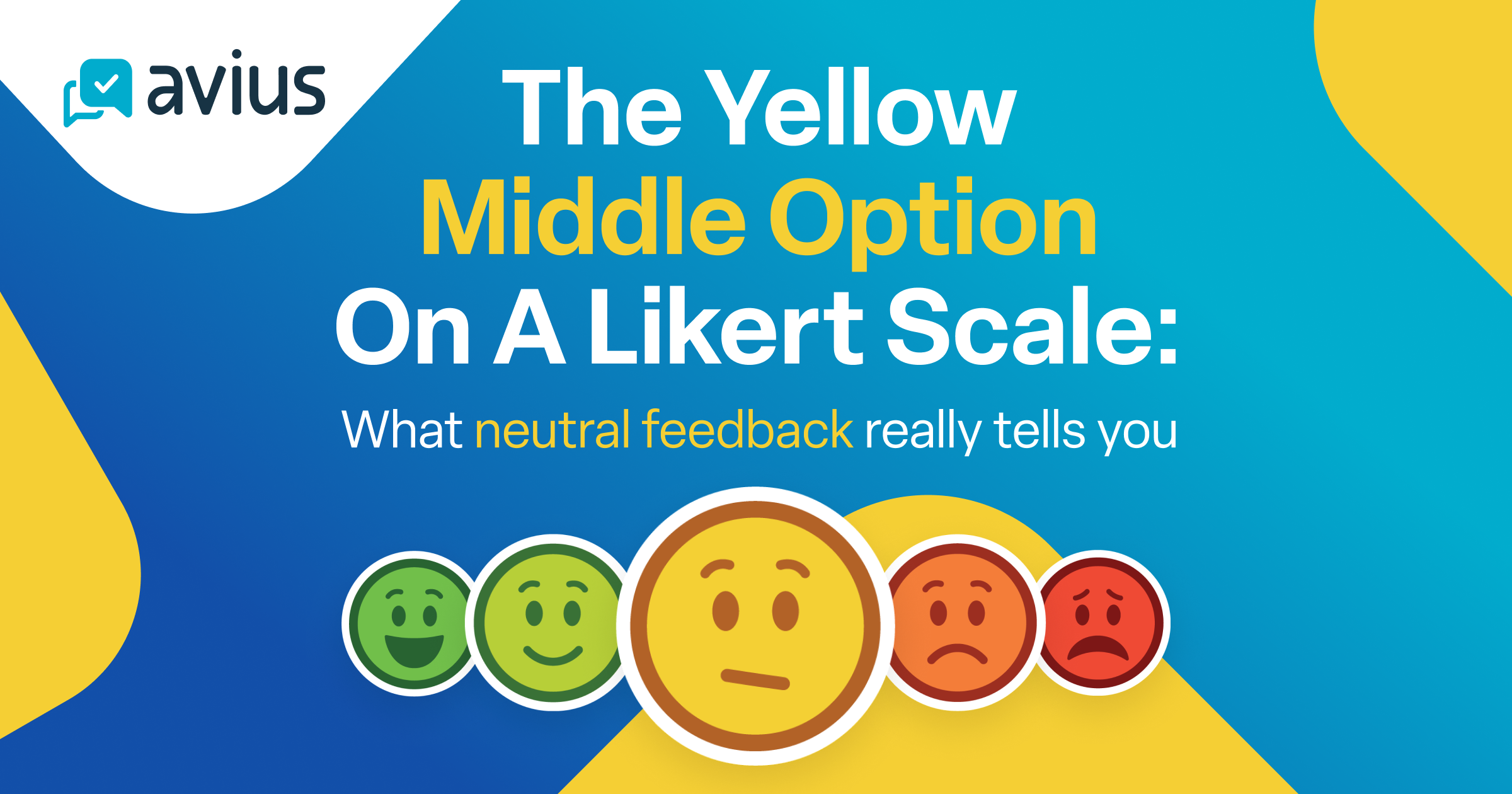
There are many ways to measure how people feel about an experience, and the Likert scale is one of the most widely used. Traditionally, organisations use a 5-point scale, sometimes a 7- or 9-point version, typically in odd numbers so there is a clear middle option. Yet increasingly, we see 4-point scale using two greens and two reds with no middle yellow option at all.
Why remove the middle option?
And does doing so really give businesses better insight?
Let’s take a closer look.
Why some companies use 4-point scale (no middle option)
A 4-point Likert scale – sometimes called a forced-choice scale – removes the neutral option and pushes respondents to choose either positive or negative.
The rationale usually includes:
- Simplicity – Fewer options look cleaner and easier to interpret.
- Clearer KPIs – Results split neatly into “good” and “bad.”
- Definitive answers – Businesses want people to “pick a side.”
- Stronger operational signals – Every response demands action.
On the surface, this seems logical. If someone must choose between positive and negative, surely the data becomes clearer?
But this logic assumes that the middle yellow option does not add value.
And that’s where the misunderstanding begins.
The Misconception: “The yellow face is no opinion”
The common assumption is that the middle face represents:
- No opinion
- Indifference
- A safe or lazy choice
- Data “noise”
- It doesn’t tell you anything
In reality, the middle response is just as honest and revealing answer on the scale as other options, ignoring it can be a missed opportunity.
Clarifying the scale
A 5-point Likert scale captures two important dimensions:
- Direction (positive vs negative)
- Intensity (how strong that feeling is)
The middle option is not accidental, it exists because real-world experiences are rarely binary.
When you remove it, you force people to pick a side, which can misrepresent how they really feel.
The middle face is not emotionless
The yellow option does not mean “nothing happened.”
It often represents:
1. Mixed Experiences
Something worked. Something didn’t.
The two offset each other, for examples:
- The queue was long, but staff were friendly.
- The restroom was clean, but supplies were missing.
- The exhibit was impressive, but confusing to navigate.
2. Cognitive Balancing
Visitors are actively weighing positives against negatives.
They are not disengaged, they are evaluating.
3. Emotional Uncertainty
“I don’t regret coming, but I’m not delighted either.” The middle face isn’t a lack of feeling, it usually means the experience wasn’t that black and white.
Passive ≠ Indifferent
People who select the middle option are often still engaged with the experience. They care enough to respond, but they may not feel strongly enough to either praise or criticise.
Often they are:
- Reflecting on a mixed experience
- Weighing positive and negative moments
- Unsure which side of the scale best represents their overall feeling
In other words, they are undecided, not disengaged.
Promoters tend to speak up when things are great.
Detractors respond when something has clearly gone wrong.
Those in the middle are taking a moment to reflect, and that moment of reflection can reveal some of the most valuable insight into the experience.
Psychological safety: “I don’t have to pick a side”
The yellow face reduces the emotional pressure of feedback.
It:
- Gives permission to be honest
- Reduces exaggeration
- Avoids “survey guilt”
- Lowers the emotional cost of participation
This matters especially in environments like:
- Attractions
- Airports
- Museums
- Public services
When you remove the middle option, some people would simply stop responding because they couldn’t decide.
The yellow option as an early warning signal
Middle scores often appear before dissatisfaction turns negative.
When the yellow percentage rises, it may indicate:
- Service inconsistency
- Time-of-day performance dips
- Minor friction accumulating
- Standards slipping gradually
Without the middle option, you only see the issue once it turns red, and by then, recovery is harder.
Middle yellow options are the “convertible” audience
From a strategic perspective, the middle group is incredibly valuable.
They are:
- The easiest group to move into positive
- One small improvement away from “happy”
- One repeated failure away from “unhappy”
If detractors tell you where you failed, the middle tells you where you can still win.
Removing the yellow option means losing visibility of your most influenceable audience.
Operational insight beats vanity metrics
A high average score can hide a large proportion of middle responses.
For example:
- 70% positive
- 25% middle
- 5% negative
At first glance, performance looks strong.
But a rising middle share might indicate creeping inconsistency.
Tracking yellow trends can reveal:
- Specific touchpoint friction
- Department-level variation
- Shift or staffing issues
- Seasonal performance dips
Segmenting and monitoring middle responses over time often provides more strategic insight than simply reporting “% positive.”
4-Point vs 5-Point: What’s the real difference?
| 4-Point Scale | 5-Point Scale |
|---|---|
| Forces a side | Allows honesty and hesitation |
| Cleaner dashboards | Richer nuance |
| Binary action | Strategic insight |
| Strong signals | Early warning signals |
A 4-point scale can be useful only when:
- You want people to make a clear choice
- You’re measuring compliance
- You need rapid operational triggers
But in experience-driven industries where journeys are complex and emotions are layered, nuance matters.
Forcing people to pick a side doesn’t always make things clearer for the business, sometimes it just skews the results and hide the areas need attention.
Conclusion: The yellow middle option provides deeper insight
There are situations where a 4-point Likert scale makes sense. If your objective is to push respondents to choose a side, or to simplify KPI reporting, it can be effective.
However, in most customer experience contexts, a 5-point scale including the yellow middle option provides deeper, more truthful insight.
The middle option in the Likert scale captures complexity, signals early friction, identifies the most convertible audience.